

Roughly 30,000 new CPG products hit U.S. shelves each year, yet only about 15% remain commercially viable after 24 months, according to Eightx. That means most new products need stronger consumer validation before launch.
Testing with real consumers helps brands identify problems with the product, packaging, positioning, and overall experience before those issues become too expensive to fix. Working with a consumer product testing company can also help brands reach the right audience and manage the testing process more efficiently.
In this guide, we'll cover what to test, which research method fits each question, how to recruit the right consumers, what to measure, and the common mistakes that can weaken pre-launch testing.
The Real Cost of Skipping Pre-Launch Product Testing
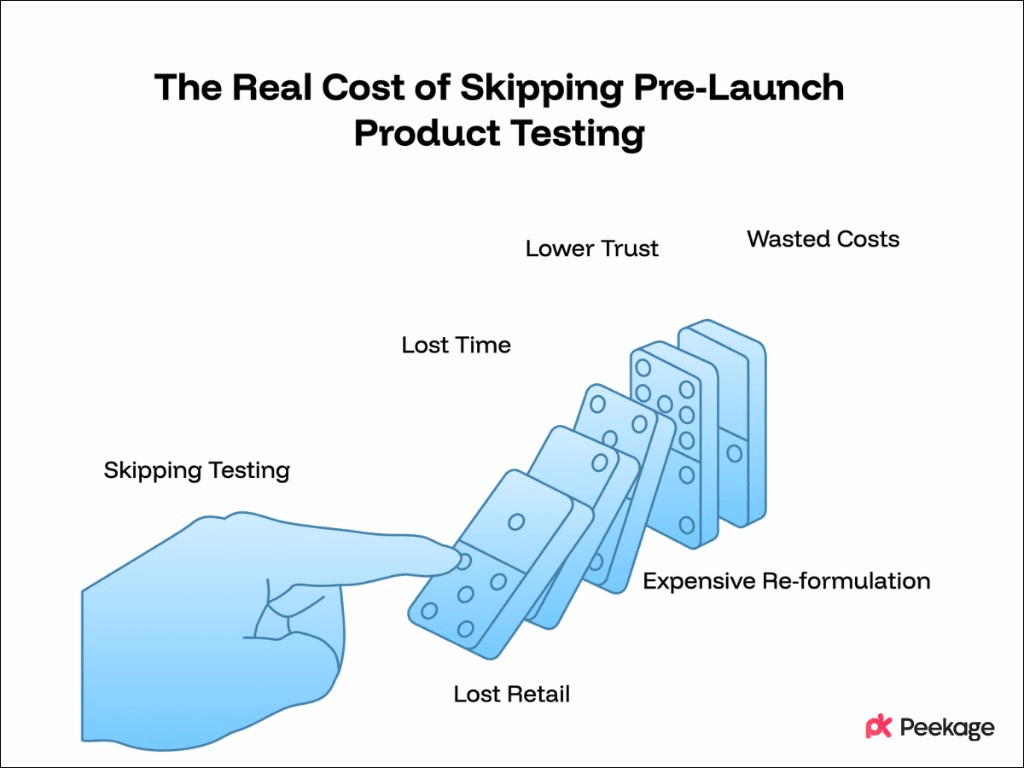
The cost of fixing a product usually increases as it gets closer to launch. Once packaging, production, distribution, and marketing are in motion, even a small product change can become expensive.
Research from BCG estimates that around 76% of CPG launches fail each year.
A failed launch can also affect more than the immediate product. Poor consumer response can lead to:
- Wasted production and packaging costs: You may be left with inventory, packaging, or materials that cannot be easily reused.
- Lost retail opportunities: Weak sales can make retailers less willing to give the product shelf space or support future launches.
- Lower consumer trust: A disappointing product experience can make consumers less likely to try another product from the brand.
- Expensive reformulation: Fixing the product after launch often means changing packaging, manufacturing, inventory, and marketing materials.
- Lost time: Teams may spend months developing and launching a product that then needs to be withdrawn, reformulated, or repositioned.
Pre-launch testing gives brands an opportunity to find these problems while they can still make changes. The goal isn't to guarantee a successful launch. It's to reduce avoidable risk before production and distribution make those decisions more expensive.
| What you skip | What it costs later |
|---|---|
| Concept validation | Full development spend on an idea nobody wanted |
| In-home product testing | Reformulation priced at production scale |
| Packaging and claims testing | Reprint costs, plus a shelf that doesn't convert |
| Purchase intent measurement | Retail slots filled with slow movers |
What Should You Test Before Launching a CPG Product?
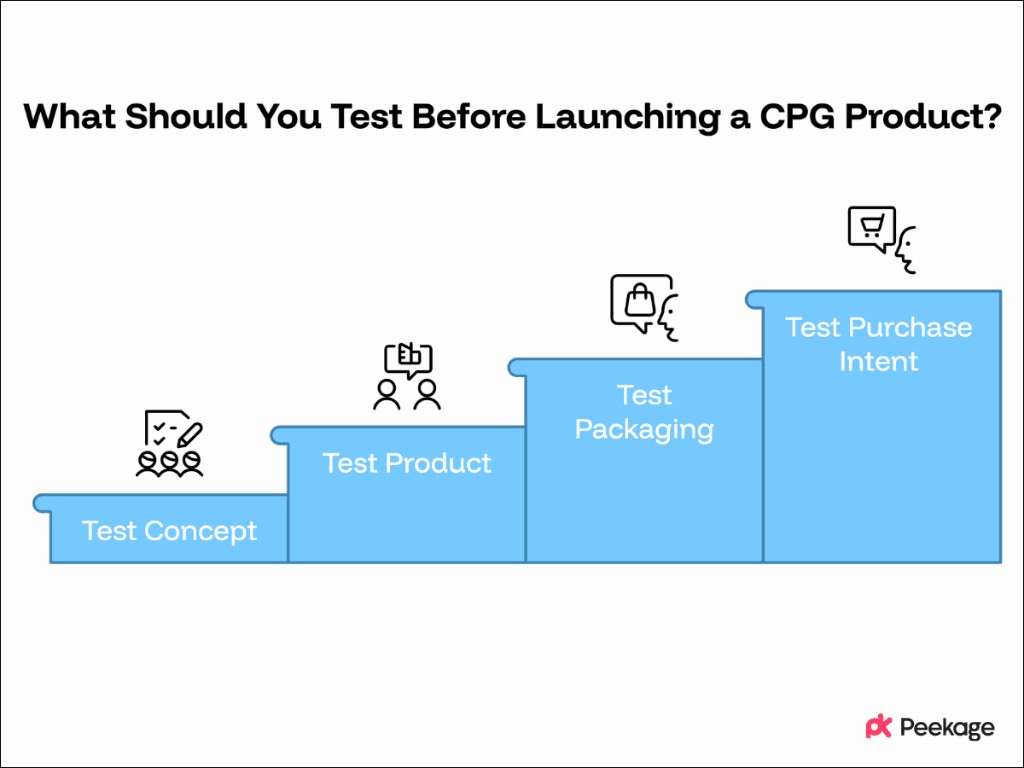
Pre-launch testing should cover more than whether consumers like the product. Test the idea first, then the actual product experience, how the product is presented, and whether consumers would consider buying it.
Test the Product Concept Before Final Development
Start with the idea before investing heavily in formulation and production. Concept testing puts a product description, visual, or early prototype in front of consumers to measure appeal, relevance, differentiation, and purchase interest.
Hanover Research found that 37% of concepts are terminated during concept testing, showing how early testing can help brands avoid investing further in ideas that are unlikely to succeed.
Test the Product With Real Consumers
Once you have a physical product, test how your target consumers actually experience it. An IHUT can reveal issues with taste, texture, scent, performance, packaging, convenience, or repeated use that a concept test cannot capture.
Test Packaging, Claims, and Messaging
Your packaging needs to attract attention, communicate the product clearly, and help consumers understand how to use it. Test whether shoppers notice the pack, understand the key claims, and find the information they need.
You can also test different messages, claims, or packaging concepts before committing to a final version.
Test Purchase Intent Before Going to Market
A product can receive positive feedback and still struggle to convert that interest into a purchase. Measure purchase intent at the expected price point and compare results across your target segments.
This helps you understand whether consumers simply like the product or would actually consider buying it.
Which CPG Consumer Testing Method Should You Use?
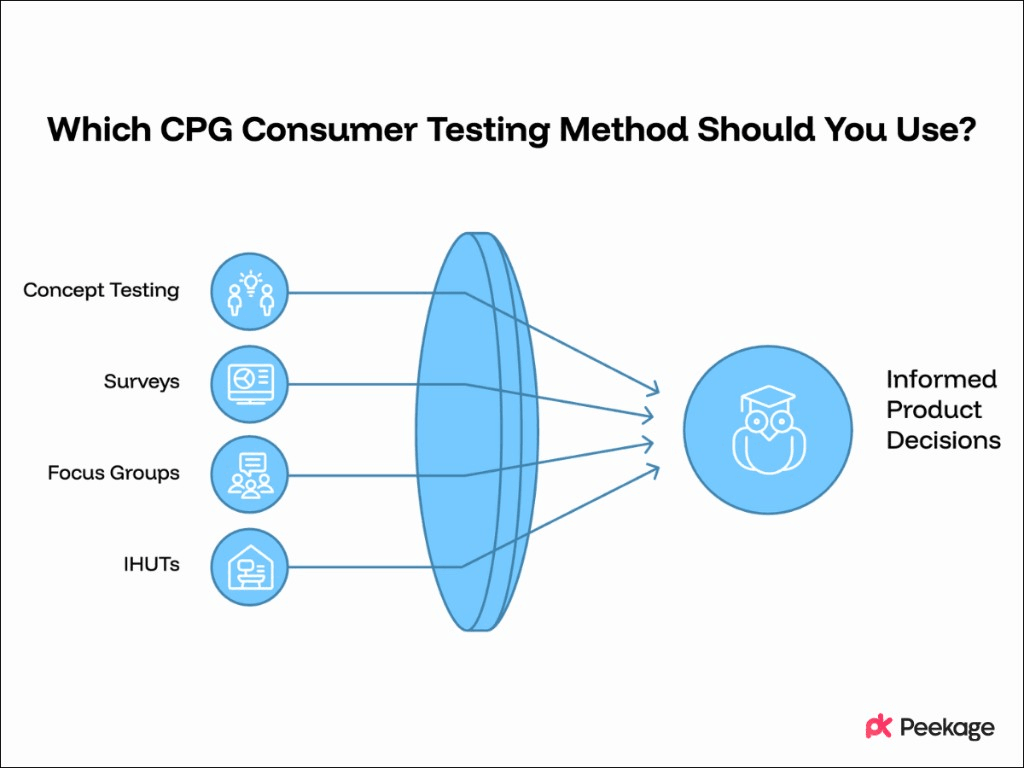
There are different research methods like focus groups, surveys, and in-home product testing. Each research method answers a different question. The best choice depends on what you need to learn and where the product is in development.
Concept Testing for Early Consumer Reactions
Use concept testing services before the product is fully developed to evaluate the idea, positioning, claims, visuals, and initial purchase interest. It can help you narrow several early concepts before investing in formulation and production.
Surveys for Measuring Preferences at Scale
Use surveys when you need quantitative feedback from a larger audience. They work well for measuring preferences, purchase intent, pricing, and differences between consumer segments.
Focus Groups for Exploring Consumer Opinions
Use focus groups when you need to understand why consumers react to an idea, product, or message in a particular way. They are useful for generating hypotheses and identifying language or concerns to explore in later research.
IHUTs for Testing Products in Real Homes
Use an IHUT once you have a physical product and need to understand how consumers experience it in everyday conditions. How IHUT testing works is straightforward: participants use the product over several days or weeks and provide feedback on performance, convenience, satisfaction, and repeated use.
| Method | Main question | Best used |
|---|---|---|
| Concept testing | Is the idea worth developing? | Early development |
| Surveys | What do consumers prefer, and how do segments differ? | Quantitative research at any stage |
| Focus groups | Why do consumers react this way? | Exploration and hypothesis building |
| IHUT | How does the product perform in real use? | Product validation and pre-launch |
A common path is to use several methods together: concept testing to narrow the idea, surveys or focus groups to explore consumer response, and IHUT to validate the physical product in real homes.
How to Find Real Consumers to Test Your CPG Product
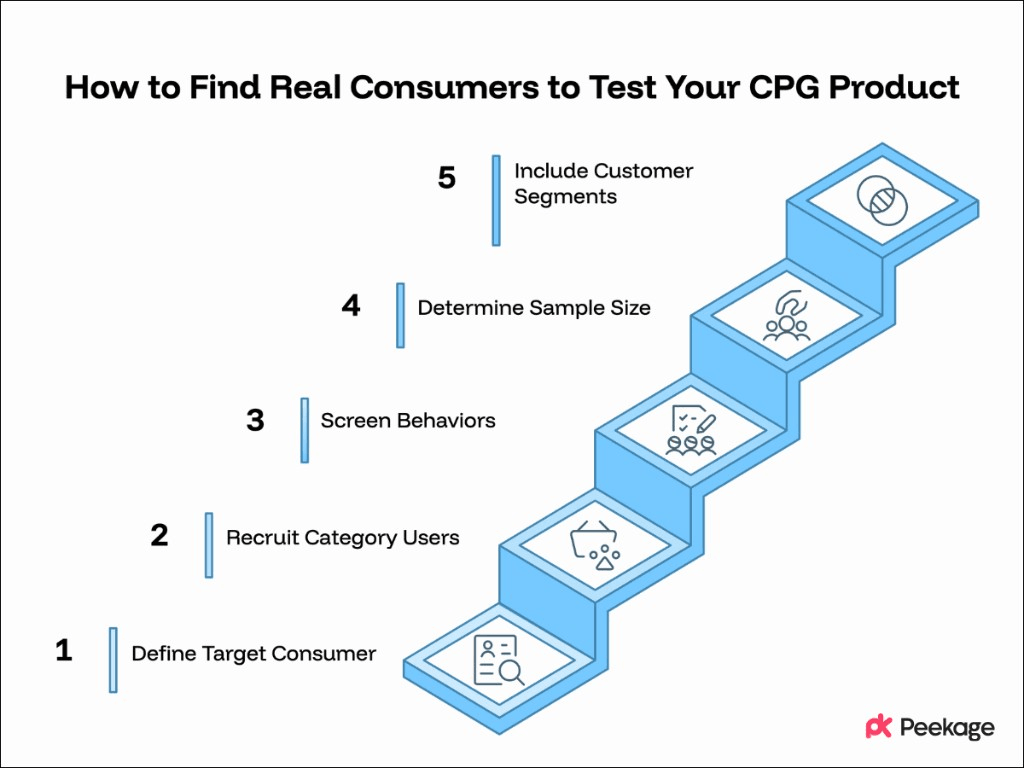
Recruitment determines whether your test results reflect your actual target market. Knowing how to recruit real consumers starts with a clear consumer profile, followed by screening for the behaviors and characteristics that matter to your product.
Define the Target Consumer Before Recruiting
Write down who the product is for in specific terms: category usage, purchase frequency, household situation, price tier, and location. "Women 25 to 54" isn't enough. "Women 25 to 54 who buy dry shampoo at least monthly and typically spend more than $12" gives you a much more useful recruitment profile.
Recruit People Who Actually Buy or Use the Category
Prioritize people with recent category experience. Someone who buys oat milk every week can give you more useful feedback on taste, texture, and packaging than someone who is simply interested in trying it.
Screen Participants Based on Relevant Behaviors
Ask about actual behavior rather than relying only on stated preferences. Recent purchase frequency, brands used, occasions, and typical spending can help confirm that someone belongs in your target group. Also screen out industry employees and people who take research studies too frequently.
Decide How Many Consumers You Need
Your sample size should match the research objective. Smaller samples can work for exploratory feedback, while quantitative research and comparisons between consumer segments require more participants.
For example, you might use 50 to 75 consumers for a directional read and increase the sample when you need more precise estimates or want to analyze several segments separately. Sample size should ultimately depend on your required confidence level, margin of error, and study design.
Include Current Customers and Potential Customers When Relevant
Existing customers can tell you whether a new product fits your brand and current range. Competitors or non-customers can show whether the product has enough appeal to attract new buyers. If you include both, analyse them as separate segments rather than combining their responses into one average.
How to Run a Pre-Launch CPG Product Test
Before you recruit anyone, define what you need the test to tell you and how you'll use the results. A clear process keeps the study focused and gives you time to act on the findings before launch.
Set the Research Questions Before Recruiting Participants
Start with the decision you need to make. Do you need to know whether the formula performs better than the current version, whether consumers understand the packaging, or whether they would buy the product at the planned price?
Turn those decisions into specific research questions. For example, instead of asking "What do consumers think?", ask "Does the new formula improve aftertaste among weekly category buyers?" Your questions then determine the research method, sample, and survey.
Give Consumers the Product and Clear Testing Instructions
If you're running an IHUT, give participants clear instructions that reflect how you expect the product to be used. Specify how much to use, how often to use it, how long to test it, and when to complete each check-in.
Collect feedback at different points in the study. A first-use survey captures initial reactions, a mid-study check-in reveals early issues, and an end-of-study survey shows whether the experience holds up after repeated use. Leave room for open-ended feedback so participants can flag problems you didn't anticipate.
Review the Results Before Making Final Launch Decisions
Analyze the results while there's still time to make changes. Look for differences between first-use and end-of-study feedback, as well as patterns across your target consumer segments.
Don't treat every negative comment as a reason to reformulate. Use the data to identify which product attributes actually affect satisfaction or purchase intent. Key driver analysis can help show which attributes have the strongest relationship with purchase intent.
What Should You Measure in a Pre-Launch Consumer Test?
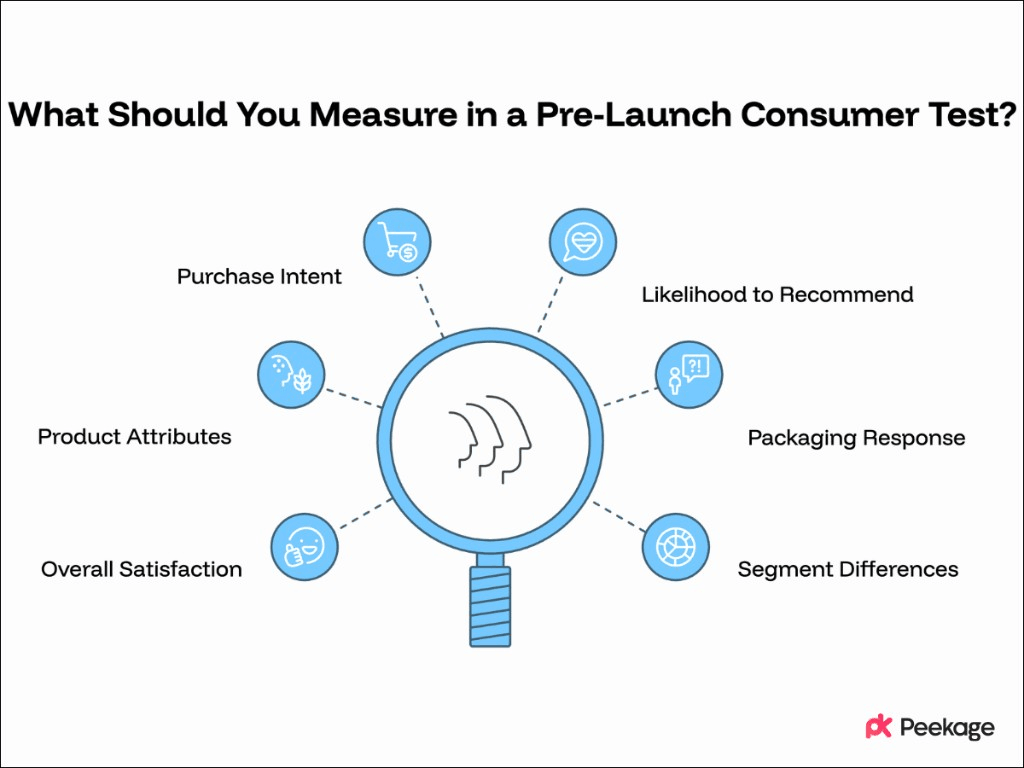
Measure more than whether consumers say they like the product. The strongest pre-launch tests connect overall satisfaction with specific product attributes, purchase intent, and differences between your target segments.
- Overall Product Satisfaction: Measure satisfaction after first use and again at the end of the test. The change between the two scores can show whether the product experience improves, stays consistent, or declines with repeated use.
- Product Attributes: Ask consumers to rate the attributes that matter to your category, such as taste, scent, texture, effectiveness, appearance, or ease of use. Driver analysis can then show which attributes have the strongest relationship with overall satisfaction or purchase intent.
- Purchase Intent: Ask whether consumers would buy the product at the planned price. Compare the results with your category or previous product benchmarks rather than treating one score as a universal pass or fail.
- Likelihood to Recommend: Measure whether consumers would recommend the product to friends or family. This provides another view of consumer advocacy alongside purchase and repurchase intent.
- Packaging and Messaging Response: Check whether consumers understand what the product is, what it does, who it is for, and how to use it. A package can look appealing while still failing to communicate the information shoppers need.
- Differences Between Consumer Segments: Break the results down by relevant groups, such as heavy category buyers, competitive users, current customers, or different price tiers. A strong overall score can hide important differences between segments.
Common CPG Product Testing Mistakes to Avoid
Even a well-designed test can produce weak results if the wrong people participate or the findings are interpreted poorly. Avoid these common mistakes:
- Testing Only With Existing Brand Fans: Loyal customers may be more forgiving of product problems and more likely to give positive feedback. Include new, competitive, or category buyers when they are part of your target market.
- Recruiting Consumers Who Don't Match the Target Market: A large sample doesn't help if the participants aren't representative of your intended buyers. Screen for relevant behaviors, purchase habits, and demographics before selecting your final sample.
- Waiting Until the Product Is Finished to Start Testing: Testing too late leaves little room to act on negative feedback. Test concepts, prototypes, packaging, and product experiences at stages where changes are still practical and affordable.
- Asking Questions That Don't Support a Decision: Every question should help you make a product, marketing, or launch decision. Remove questions that don't add useful information or directly support the research objective.
- Treating Every Piece of Feedback as Equally Important: One strong comment doesn't necessarily represent a wider problem. Look for patterns across participants and combine open-ended feedback with quantitative results before deciding what needs to change.
How Peekage Helps CPG Brands Test Products With Real Consumers Before Launch
Peekage gives CPG brands access to a panel of 5+ million consumers and 200+ targeting attributes, including demographics, purchase habits, dietary preferences, household characteristics, and more.
Brands can use this audience to run demographic forecasting across factors such as age, gender, income, location, and household composition, then compare how different groups respond to the product.
If the existing filters don't cover your criteria, you can add custom screening questions to identify consumers with specific experiences, behaviors, or category usage. This makes it easier to build a sample that matches your target market rather than relying on broad demographic assumptions.
From there, Peekage can support the full testing process, from participant recruitment and screening to product shipping, feedback collection, and results analysis.
You can use concept testing to evaluate an idea early, demographic testing to understand which consumer groups respond most strongly, and product testing or IHUT testing services to see how the physical product performs in real-world use.
The platform also helps you compare results across consumer segments and identify which product attributes influence purchase intent, giving your team actionable insights before launch.
If you're preparing for a launch and want to understand how different consumer groups respond to your product, contact the Peekage team to discuss your testing goals.